The web development landscape has experienced a massive paradigm shift in recent years, moving away from monolithic, server-heavy platforms toward modular, decoupled architectures. At the heart of this movement is Static Site Generation (SSG) - a core pillar of the Jamstack philosophy.
Today, this architecture is not just about serving human users faster; it has become the foundational requirement for the new era of AI-driven search. Whether you are launching a high-traffic marketing site, a sprawling knowledge base, or an interactive web application, SSG offers profound advantages.
Below, we dive into the mechanics of Static Site Generation, explore why AI models like ChatGPT and Google’s AI Overviews increasingly rely on it as a source of truth, and define why we champion our internal stack of Bootstrap, Hugo, and CloudCannon (while remaining flexible enough to adapt to any headless CMS or Jamstack configuration you prefer).
What is Static Site Generation?
At its core, a static website is one where pages are generated ahead of time and delivered to the browser as ready-to-render files (HTML, CSS, and JavaScript).
A static website shifts the heavy lifting of page generation out of the request cycle and into a build step. Instead of querying a database and assembling a page every time a user visits, the site is prepared in advance and served instantly.
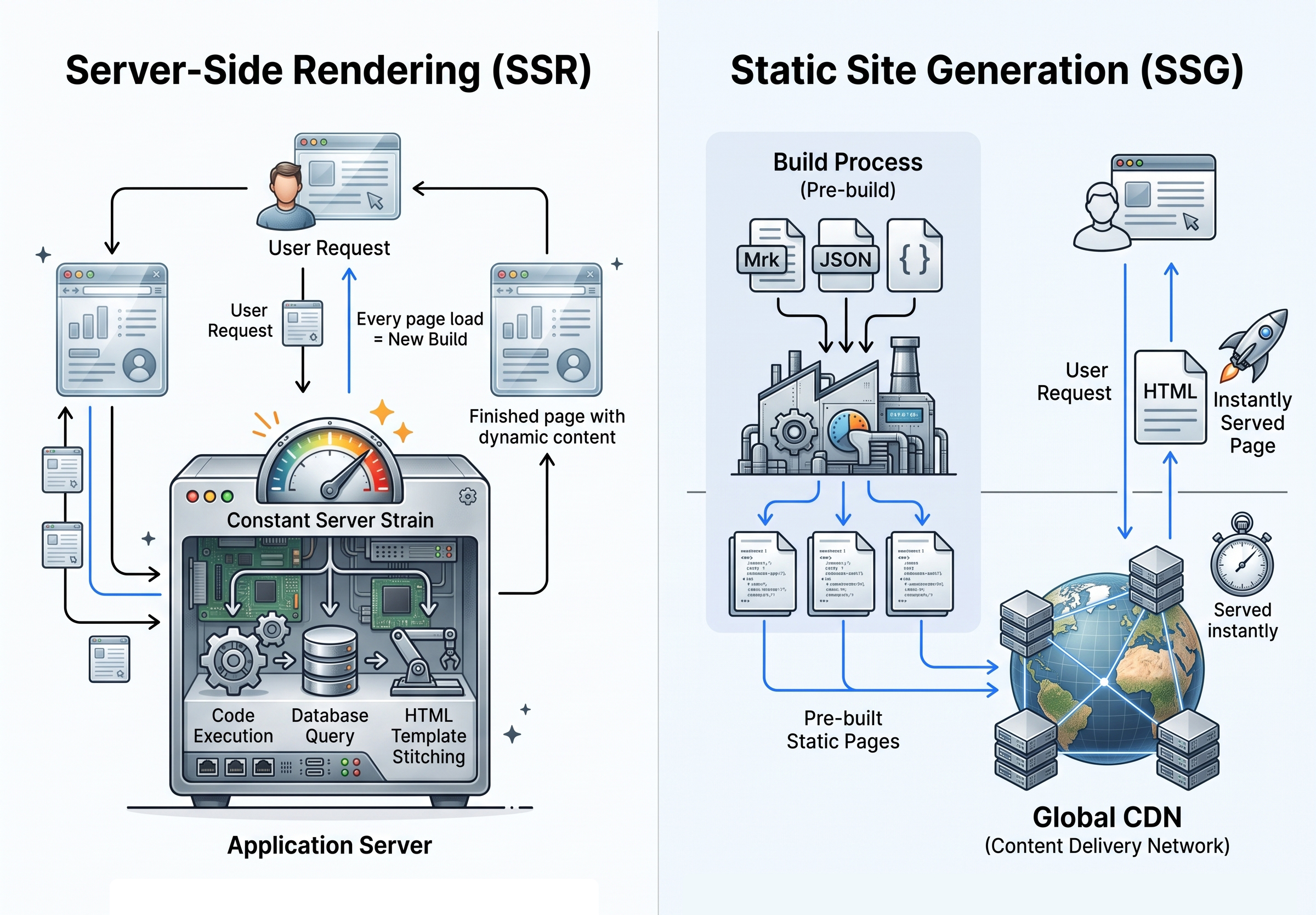
To understand SSG, it helps to contrast it with the traditional alternative: Server-Side Rendering (SSR).
- Server-Side Rendering (SSR): When a user requests a page, the server executes code, queries a database, stitches the data into an HTML template, and then sends the finished page to the user. This is great for highly dynamic, personalised data, but it puts constant strain on server resources. Every single page load necessitates a new page build.
- Static Site Generation (SSG): SSG converts source files (like Markdown or JSON) into structured HTML pages before the user ever arrives. Because these pages are static, they can be deployed to a global Content Delivery Network (CDN) and served instantly.
The Four Pillars of SSG Benefits
Why have modern engineering teams moved to SSG? The traditional advantages fall into four primary categories:
- Blazing Fast Performance: This global Content Distribution Network reduces latency, meaning a user in gets the site delivered from the nearest data center within their own localised network. Regardless if you have business in Tokyo, New York or any place in between the experience will be consistent and fast.
- Enhanced Security: Dynamic site frameworks (like WordPress) expose a larger attack surface by default. It all comes down to dependencies. At minimum there is a need for a framework to run the framework, a database, a set of plugins, then more plugins, a layer to optimise the framework and the plugins, all of which are exposed to the public internet with a requirement of frequent audits at every step as not everything receives security updates with the same cadence. Should things go wrong, repairing the server and dealing with restoring from backup data becomes quite the hassle. By removing on-demand server-side processing, employing a per content change backup strategy and generating the entire site statically we miminise the risk surface considerably.
- Infinite Scalability: If a traditional site goes viral, the sudden influx of database queries can crash the server. With SSG, scaling is nearly infinite. CDNs are designed to handle massive traffic spikes by simply serving the same static files repeatedly.
- Superior SEO: Search engines love fast, crawl-able websites. Because SSG delivers fully formed HTML documents on the very first load, search engine bots can easily read and index the content without having to execute complex client-side JavaScript.
The AI Frontier: Why LLMs Rely on Static Architecture
The shift toward SSG has unexpectedly positioned it at the center of a rapidly emerging engineering discipline: Generative Engine Optimisation (GEO).
AI models like ChatGPT, Claude, and Google’s AI Overviews do not “browse” the web like humans do; they consume it as a data pipeline. When these engines need a source of truth, they rely on Retrieval-Augmented Generation (RAG) to fetch, synthesise, and cite external information. For these systems, dynamic, JavaScript-heavy websites are difficult and expensive to digest, whereas SSG provides exactly the structured, pre-processed “food” they are engineered to ingest.
The Compute Overhead of JavaScript Execution
When an AI bot (like OpenAI’s GPTBot) crawls a traditional Single Page Application (SPA), the initial HTML document it receives is essentially empty. To “see” the content, the crawler must spin up a browser, execute the JavaScript, and wait for the website to render. Because AI companies are crawling billions of pages to update their models, their bots operate on strict timeouts and will frequently abandon pages that require heavy rendering. SSG bypasses this entirely by delivering the complete text and data on the first HTTP request.
Token Budgets and Semantic Chunking
LLMs do not understand visual web design; they understand tokens. Before an AI can use your content to answer a user’s question, it must strip away the code and chop the text into semantic “chunks” to store in a vector database. Site builder frameworks (Divi, Elementor) that sit on top of a dynamic site generator are notorious for generating bloated, deeply nested code that confuses automated parsers. SSG frameworks output clean, semantic HTML (<article>, <h2>, <table>), allowing the LLM to isolate specific facts and ingest the data with high fidelity.
Pre-Baked Schema and Entities
When an AI answers a question, it looks for machine-readable context (like Schema.org structured data) to understand entities (authors, products, dates). In dynamic sites, this data is often injected client-side. SSG bakes this structured data directly into the HTML at build time, making the structural clarity of the site a highly trusted, easily verifiable source of truth for the AI.
By building with an SSG foundation, you are essentially pre-digesting your data for Large Language Models.
Our Internal Stack: Bootstrap, Hugo & CloudCannon
While we build across the entire Jamstack ecosystem, we have curated an internal stack that allows us to deliver high-performance, AI-optimised, and easily manageable websites at rapid speeds.
Bootstrap: The UI Foundation
For styling and layout, we lean on Bootstrap. As one of the most battle-tested CSS frameworks in the world, it provides a robust, responsive grid system and an extensive library of accessible components, allowing our developers to prototype rapidly while ensuring cross-browser compatibility.
Hugo: The Engine
Hugo is an open-source static site generator written in Go. Its defining feature is raw speed. While other SSGs can take minutes to build a large site, Hugo routinely compiles thousands of pages in milliseconds. Not only does this instantaneous build time completely transform the developer experience, but Hugo’s strict adherence to clean, semantic HTML generation makes its output the perfect feed for AI crawlers and LLMs.
CloudCannon: The Visual CMS
The historical drawback of SSG was that managing Markdown files in Git repositories was too technical for marketing teams. CloudCannon bridges that gap beautifully. It is a Git-based, visual Content Management System designed specifically for Hugo (and other SSGs). It provides content editors with a rich, visual interface - allowing them to build pages using custom blocks without writing a line of code - while preserving the developer workflow entirely in version control.
Flexibility First: We Are CMS & Framework Agnostic
While Bootstrap, Hugo, and CloudCannon form our highly optimised stack, we remain completely unbiased and adaptable.
The beauty of the decoupled Jamstack architecture is that the front-end presentation is entirely separate from the back-end content repository. If your team already has a preferred tech stack or an enterprise CMS contract in place, we seamlessly integrate with it.
- Headless CMS Preferences: If your content teams prefer managing structured data in Sanity or Contentful, we wire those APIs into the build process.
- Framework Preferences: If your engineering team requires React-based ecosystems for complex interactive applications, we regularly build with Next.js, Gatsby, or Astro. Modern frameworks like Next.js even allow for hybrid approaches (like Incremental Static Regeneration) where you can blend SSG and SSR on a page-by-page basis.
Static Site Generation isn’t just a trend; it’s a structural evolution in how the web is built. By decoupling the front-end from the back-end, we can deliver experiences that are secure, lightning-fast, infinitely scalable, and optimised for both human users and the next generation of AI search engines.
Get in touch with us today if you’d like to make the switch, or even just to find out more.
Disclaimer
The information provided in this blog is done on a best effort basis. No warranty and or guarantees are given or implied.